
ATLANTA, Ga. (Atlanta News First) - The new year is upon us, and as baseball settles into its familiar offseason lull, Hall of Fame discussions once again take center stage.
Atlanta Braves legend Andruw Jones is currently in his ninth year on the Hall of Fame ballot, and he has a pretty compelling case this time around. Well, Jones has always had a strong Hall of Fame resume, but with a weaker ballot and a 66.2 percent showing in his eighth year, this could finally be the year he earns baseball’s greatest honor.
RELATED: Braves great Dale Murphy falls short in Baseball Hall of Fame voting
The statistics
Jones was not only a wizard in the outfield. He hit for power, too.
Along with his 10 Gold Glove awards -- He is one of four outfielders to win exactly 10, along with Ken Griffey Jr., Al Kaline and Ichiro Suzuki -- Jones crushed 434 home runs, including an MLB-leading 51 in 2005, and averaged 32 in 162 games across 17 seasons. From 1998-2006, he hit 316 of those home runs. Jones is one of four players in MLB history to hit 400 home runs and earn 10 Gold Glove awards. The other three -- Ken Griffey Jr, Willie Mays and Mike Schmidt -- are all in Cooperstown.
ADVERTISEMENT
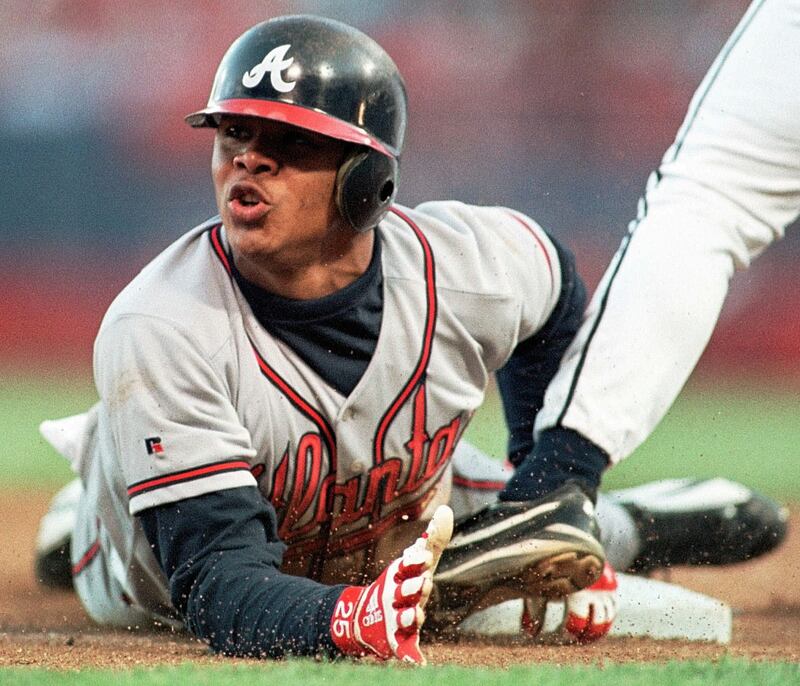
Nonetheless, Jones’ peak was otherworldly.
Offense aside, Jones accumulated 24.4 defensive WAR, per Baseball Reference, in his career, the most of any outfielder in MLB history. There’s no question he’s among the best defensive center fielders of all time.
From 1998-2007, Jones saved 265.9 more runs than an average defender. That’s 113 more runs saved than the next best defender (Ivan Rodriguez) and 167 more than the next best outfielder (Darrin Erstad) over that same span.
But after leaving Atlanta in 2008, Jones slashed .210/.316/.424 with 66 home runs across four seasons with the Los Angeles Dodgers, Texas Rangers, Chicago White Sox and New York Yankees.
That steep drop-off is likely the reason for his lack of support over the years when it came to Hall of Fame voting. He received 7.3% of the vote from the Baseball Writers’ Association of America in 2018 and 7.5% in ’19. Since then, that number has risen to 19.4% in ’20, 33.9% in ’21, 41.4% in ’22, 58.1% in ’23, 61.6% in ’24 and 66.2% in ’25.
ADVERTISEMENT
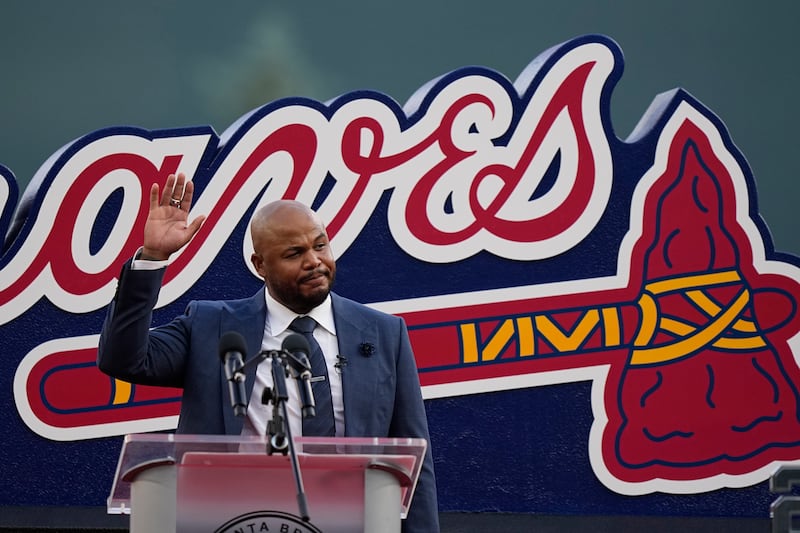
Candidates need 75 percent of the vote to be inducted into the Hall of Fame.
In comparison, Hall of Famer and former Brave Billy Wagner was inducted into the Hall of Fame last year after not receiving more than 20 percent during any of his first four years on the ballot. But over his final three years of eligibility, Wagner jumped from 68.1 (2023) to 73.8 (2024) to 82.5 (2025).
Scott Rolen faced a similar situation, debuting on the ballot with 10.2% in 2018 and climbing his way to 76.3% in 2023.
Jones is aiming for that late surge, and voting trends indicate he’s on the right track.
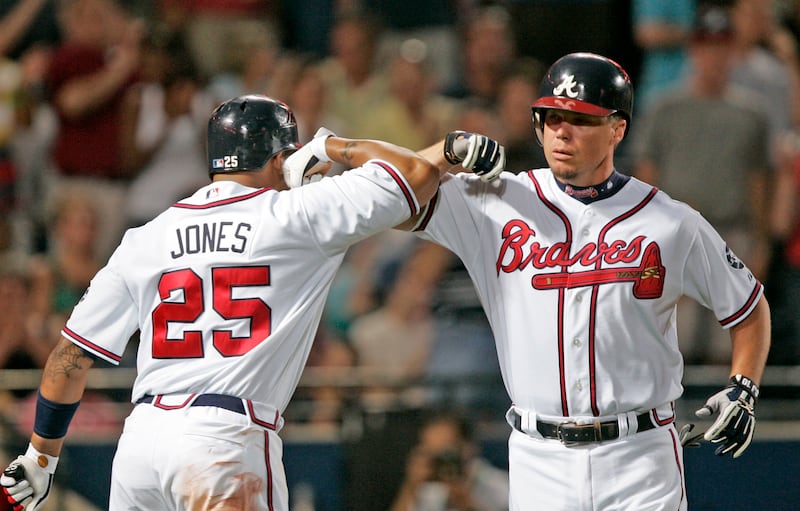
The ballot
Besides Jones, the only other realistic candidate to gain entry to Cooperstown is Carlos Beltran, the switch-hitting outfielder who accumulated over 2,700 hits and 400 home runs across 20 seasons with seven teams, primarily the Kansas City Royals and New York Mets.
Per Ryan Thibodaux’s Hall of Fame tracker, Beltran has 87% of the 123 ballots recorded, while Jones has 82.8%. Philadelphia Phillies legend Chase Utley (65%) and Seattle Mariners flamethrower Felix Hernandez (57.7%) follow them.
Typically, over 400 writers participate in the process. While some writers publicize their ballots, most aren’t made public until voting day, and the players’ vote totals often decrease once all ballots are counted.
If Jones doesn’t reach the necessary 75 percent of the vote, he’ll have one last try in 2027 before he falls off the ballot. Candidates are removed from the ballot if they do not reach that threshold within their first 10 years of eligibility.
The Baseball Writers’ Association of America vote will be revealed Jan. 20. Those -- if any -- who reach 75 percent of the vote will be inducted into Cooperstown alongside Jeff Kent this summer.
Copyright 2026 WANF. All rights reserved.